
Insights

Archive for March, 2009

Free Website Traffic Estimation Services - How Accurate Are They?

Tuesday, March 24th, 2009

There are several reasons why an online marketer wants to know how much traffic a site other than their own is receiving:

  • You may want to compare how much traffic a competitors’ site is getting.
  • In reviewing the landscape of sites your target customers are visiting, you may want to ballpark the volume of traffic to each in order to get a sense of their relative prominence.
  • When reviewing the sources of traffic to your website, you may identify a new source that has had good conversion success and you may want to determine if they have a significant audience and would like to see if that audience is growing. If so, you may want to pursue a more in-depth relationship with that source.
  • It may also help to provide focus in trying to establish high quality links to your site for SEO purposes.

There are now several free traffic estimation services (Amit Agarwal did a nice job of outlining these options in his article, Find Out How Much Traffic a Website is Getting). However, one obvious question is how accurate is the data?

In order to help answer that question, we evaluated the quality of these estimation services against the web analytics data collected through Omniture, Google, etc. for a subset of our clients. We thought that the quality of those estimates might vary significantly depending upon how heavy the volume of traffic was to the site being estimated. As such, we grouped the results based on site activity: heavy, moderate, and light. When available, we also evaluated how accurately the services reflected the trend of the site traffic as well as the volume of visits and visitors for the following traffic estimation services: Alexa, Compete, Google Ad Planner, Google Trends, QuantCast, and StatBrain.

The following table shows how the free sources compared to the data collected by our clients’ analytics programs (e.g. Compete’s estimation of traffic for moderate sites was lower than reported by the analytics tools used by those sites).
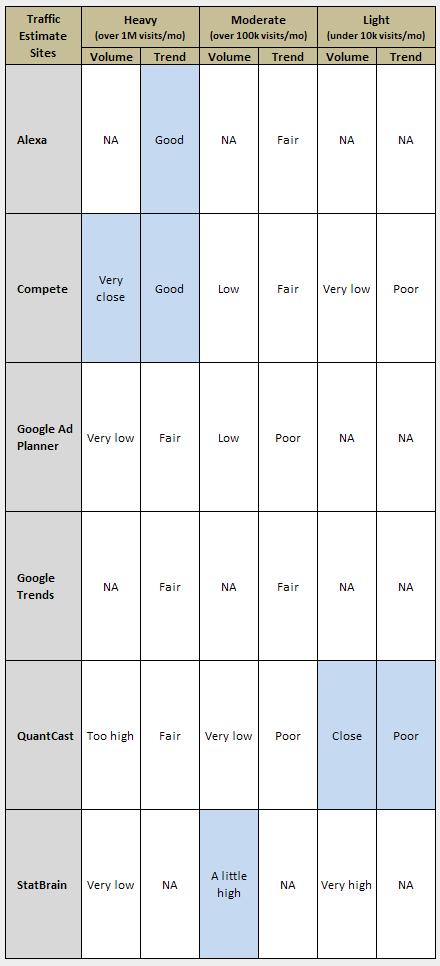
Free Traffic Estimation Comparisons

I should note that this was not a formal study, was based upon a relatively small sample set, and other factors may impact the results (e.g. relative volume of paid search marketing may influence the accuracy of some sites versus others).

A few observations/conclusions:

  1. Not surprisingly, the quality of the estimates is considerably better for higher volume websites.
  2. At this point, there does not seem to be a reliable source for viewing site trends for lower volume websites and the trends for moderate traffic websites are not much better.
  3. The growing volume of incremental demographic information being provided by some of these services is encouraging. Most of the demographic information is fairly rudimentary, but it is definitely more than what has been available in the past.
  4. You should definitely review Dataopedia.com. In addition to pulling in data from Alexa, Compete, and QuantCast, this service displays other non-traffic related data such as Google Page Rank and Twitter posts related to the site.
  5. Given that none of the free services provided accurate estimates in every scenario, you may be able to use our findings to make adjustments for your specific situation.

Has anyone else conducted a similar comparison? If so, what type of results did you find?

In Defense of the Email Open Rate (sort of)

Wednesday, March 18th, 2009

Over the past months, many have proclaimed that the email open rate is obsolete and utterly useless.  The poor open rate has become a persona non grata, and while not as risky as trying to defend the AIG bonus structure, I do think someone needs to stand-up for this email metric.

While I completely agree that clients often focus too much on the open rate, it can be misused, and it isn’t as relevant as it once was because, among other reasons, email clients are more likely today to suppress the image that is used to track an open, I do believe that the open rate still provides value and it is worth following.

Ask any professional football coach what the most important measure of success is and he will tell you that it’s all about wins and losses.  However, he will also acknowledge that when analyzing a team’s performance, you need to go beyond the end result (win/loss) and look at diagnostic metrics like how many yards you gained on offense, how many yards you gave-up on defense, how many fumbles and interceptions you had, how many penalties you incurred, etc.

I believe you take a similar approach with email marketing.  While, if I am an online retailer, I am most concerned about conversion rates and sales, metrics like the open rate provide value.  Obviously, before someone can purchase as a result of your email, they must click on a link, and before they click on a link, they have to open the email.  If you aren’t getting the email to the inbox and the subject line isn’t compelling or engaging, you aren’t going to get a conversion.

I believe that the open rate can still provide insights that will help you improve your email marketing.  If the conversion rate was significantly different between two emails and the open rate for the better converting email was much higher (and assuming the emails were sent within a reasonable time of one another), I might conclude that the subject line, whether it be the way it was written or the offer communicated, was the culprit.  Obviously, I would look at other metrics and analytics but the fact that the open rates were so different would likely impact my conclusions.  Open rates have also been helpful in identifying deliverability issues (when clients didn’t have inbox tracking) and enagement by various segments of a list (e.g. when comparing recent subscribers to ones that have been subscribed for over a year).

So what do you think?  Is it worthwhile to track the open rate or is it ready to go the way of the buggy whip?

She’s Just Not That Into Your Email Newsletter - Or is She?

Friday, March 6th, 2009

We were working with a client to help identify inactive subscribers - those who hadn’t opened or clicked on an email in many months.  The assumption was that these people no longer wanted to receive the email but just hadn’t taken the time to unsubscribe.  We were looking at various changes to the newsletter, and we were interested to see if we could learn anything from this group (e.g. why were they no longer interested in the content and what information might they find more useful) so we decided to send a small segment an online survey as a test.  The first question asked them to rate the value of the newsletter with the expectation that the newsletter would receive low scores.

The survey actually received a good response rate, especially given to whom we sent it, and the respondents gave the newsletter a surprisingly high rating (4 out of 5).  Also, interestingly, a number of people indicated that they hadn’t received an email from the company in long time. 

So, while there were certainly subscribers who were no longer interested in receiving the email newsletter, there were many that still wanted it but a deliverability problem may have been preventing the emails from getting to the inbox.  The overall deliverability to the inbox was very good for this email (as measured by a 3rd party monitoring service), but this information will allow us to work with the email service provider to identify whether there are deliverability issues that our 3rd-party monitoring isn’t discovering.

Therefore, unlike the situations where a friend was listing all of the reasons why a girl didn’t call him back and you had to have that difficult conversation informing him that she just wasn’t that into him, this was a situation in which she was (at least some of them were).